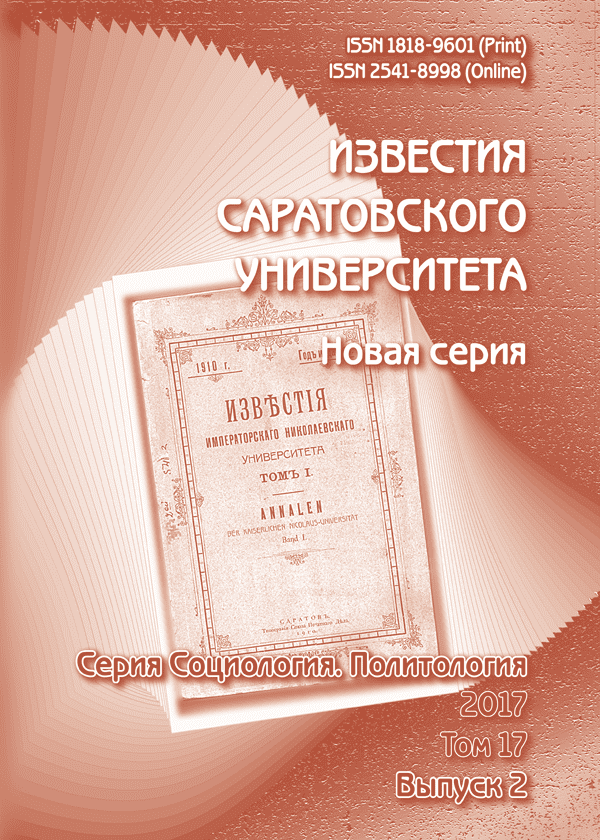
Izvestiya of Saratov University.
ISSN 1818-9601 (Print)
ISSN 2541-8998 (Online)


Scientific section. Politology

Традиционализация и архаизация транснациональных отношений в Северо-Кавказском регионе: причины, признаки

In this article, the author considers a problem which is extremely urgent for modern Russia – the specifics of the archaization of the political culture of traditionalization and the archaization of transnational relations in the North Caucasus region. The author analyzes the main reasons for the traditionalization and archaization of interethnic relations of the region, their influence on the socio-political processes in the North Caucasus republics.

На рубеже тысячелетий: геополитический «взрыв» и геополитическое возрождение России

The article analyzes the process of geopolitical transformation of contemporary world-system that began in the last decades of the 20th century – just after the defeat of the Soviet Union in the “cold war” that became a geopolitical “explosion”, geopolitical revolution, “geopolitical catastrophe”, as Vladimir Putin put it, which led to the termination of the existence of a bipolar geopolitical model, for many decades a highly reliable fastening system of international relations.

Миф политической функциональности исторической памяти в современных условиях

The article presents analysis of pragmatic motives that stimulate civil societies and governing elites in our country and throughout the world to change their attitude to historic memory and mythological views on its political functionality. Special attention is paid to the paradox taking place in Russian and foreign liberal and democratic politics.

Постсоветское коммунистическое проектирование государства

Main directions and features of communist political designing in post-soviet Russia are considered in the article. Having analyzed theoretical, program, and electoral materials of the Communist Party of the Russian Federation, the author makes an inference that modern communist leaders try to synthesize two “sovereign” projects of statebuilding – imperial and soviet ones. This project departs from class and ideological evaluations that are usual for communists.

Социальная справедливость как ценностный ориентир изменений в Конституции РФ

The article is about key value models of social justice presented in the Constitution of the Russian Federation and the level they are embodied in real social, political, and economic life of modern Russia. The author evaluates constitutional changes proposed in terms of their correspondence to popular visions of social justice and fair structure of society.

Социальные медиа как инструмент формирования политической картины мира современной молодежи (на материалах Нижегородского региона)

The article is based on the material of applied research conducted among students of N. Novgorod, studying the political values of young people developing in the communicative space of social media, the role of network space in shaping the value picture of the world of youth, taking into account the logic of development and functioning of virtual space, its features and principles. The specifics of the impact of social media on the political consciousness (perception) of youth is analyzed, the methodological basis of which was the theory of social networks, P.

Политический протест: теоретико-методологические подходы и интерпретации

The relevance of the study is due to the activation of protest moods in modern Russia, which in case of untimely reaction on the part of the authorities can take an unpredictable, destructive nature. The article is devoted to the study of different approaches in the interpretation of the concept of «protest voting», the analysis of protest voting as a form of manifestation of political protest, the definition of its universal characteristics.

Партийно-идеологический контекст изменений в Конституции РФ

The article considers party and ideological context of the way the Russian Constitution and its possible changes are perceived. Based on the analysis of stances of the leading political parties’ leaders, representing ideological segments of modern Russia, an inference is made that majority of them seek to gain political and image advantage from the discussion of the President’s bill.

Pages